Your pace. Your route. Your Himalayas. A complete guide to private guided trekking in Nepal for 2026 and beyond, from itinerary design and guide selection to curated logistics and specialist journeys for every type of traveller.
Nepal contains eight of the world's fourteen peaks above 8,000 metres, more than 1,400 trekking routes across five distinct geographic regions, and a cultural landscape that ranges from the Hindu temple cities of the Kathmandu Valley to the ancient Tibetan Buddhist communities of the high Himalayas. It is, by almost any measure, the most comprehensively extraordinary trekking destination on earth.
And yet the way most people experience it has barely changed in 40 years. A fixed-date group departure, a pre-set itinerary, an overloaded teahouse at peak season, and a guide who is dividing attention between twelve different people with twelve different fitness levels, twelve different altitudes of ambition, and twelve different ideas about what a rest day should look like.
Private guided trekking in Nepal is the alternative. It is not simply paying more for the same experience. It is a fundamentally different relationship with the mountains, the culture, and the pace of travel. It is the difference between visiting Nepal and understanding it.
This guide covers everything you need to know about private guided trekking in Nepal in 2026: what it means, what it costs, how itineraries are designed, what a genuinely excellent private guide looks like, how curated logistics work, which specialist routes are available for different types of travellers, and how Hiking Nepal approaches the responsibility of taking people into one of the most beautiful and most demanding environments on earth.
“A private guide does not just show you the trail. They show you whose trail it is, whose mountain this is, whose valley you are walking through. That is a different kind of guide entirely.”
The Evolution of Himalayan Travel: Moving Beyond the Group Tour
Commercial trekking in Nepal began in earnest in the 1960s, largely as an extension of the mountaineering expeditions that had opened the country to outsiders a decade earlier. The early model was built on group logistics by necessity: food, permits, porters, and accommodation all required coordination at scale, and the infrastructure to support individual or small-party travel simply did not exist outside the major corridors.
That infrastructure now does exist. Permit systems have become flexible and individual. Teahouse networks have expanded to cover routes that were inaccessible lodges-wise a decade ago. Domestic aviation has improved helicopter access to remote areas. Mobile networks now reach altitudes that once required satellite phones. Private jeep roads into previously walk-in-only valleys have opened new approach and exit options. The logistical barriers to bespoke Himalayan travel have been systematically dismantled.
What has not kept pace is the expectation most travellers bring. The group tour model is deeply embedded in how Nepal trekking is marketed, sold, and perceived. The fixed Everest Base Camp itinerary, the Annapurna Circuit departure calendar, the Langtang Valley group roster , these exist because they are operationally convenient and historically familiar. They are not, in most cases, the best way to experience the destination.
The Rise of the Independent-Minded Trekker
The traveller profile seeking private guided experiences in Nepal has shifted considerably over the past decade. Requests for private departures now come from solo travellers in their thirties who want safety and depth without group social obligations. They come from families with children who need flexible pacing and altitude management. They come from couples celebrating milestones who want the experience shaped around them rather than around an average. They come from professional photographers who need dawn access to specific viewpoints without a group schedule dictating departure times. They come from executives and professionals who have limited annual leave and cannot afford the inefficiency of a fixed itinerary that spends days in places they do not care about.
What connects all of them is the recognition that Nepal is too rich, too varied, and too personally meaningful to be experienced on a one-size-fits-all schedule. Private guided trekking is the mechanism for doing it on your own terms.
Private vs Group Trekking: An Honest Comparison
Factor | Private Guided Trek | Standard Group Trek |
| Itinerary | Fully custom, designed around your goals | Fixed route and fixed dates |
| Daily pace | Set by you and your guide | Set by the slowest member |
| Rest day flexibility | Add or remove at any point | Predetermined schedule |
| Cultural access | Deep, guide-facilitated, community-level | Surface-level, time-constrained |
| Guide attention | 100% dedicated to you | Divided across 8 to 16 people |
| Safety monitoring | Continuous, individual-specific | Group average, less granular |
| Route customisation | Detours, extensions, altitude choices | No flexibility |
| Dietary needs | Pre-arranged, confirmed with every lodge | Standard menu, limited options |
| Cost per person | Higher (premium worth quantifying) | Lower (efficiency at scale) |
| Departure date | Any date throughout the season | Fixed calendar departures
|
The cost differential is the most common reason travellers default to group tours without exploring private options seriously. A private guided trek typically costs 30 to 60 per cent more per person than a comparable group departure. For a solo traveller, this gap is significant. For a couple or a family of four, the per-person premium frequently narrows to 10 to 20 per cent when the efficiencies of private logistics, concentrated guide time, and eliminated compromise are factored in. For most people who have done both, the question after the private experience is not whether it was worth the extra cost. It is why they did not do it this way the first time.
Why Privacy Matters: The Advantages of a Personal Mountain Guide
The word 'private' in trekking is often understood as a luxury category, implying expense and excess. That is a misreading. Privacy in the context of guided trekking is, more precisely, a performance and safety category. When a guide is responsible for one person or one family rather than twelve, every decision, observation, and intervention is better calibrated to that specific individual's needs.
Flexibility and the Freedom of Individual Pacing
Pace is the most underestimated variable in Himalayan trekking. The standard group itinerary sets daily walking distances based on an average fitness level that, by definition, does not represent anyone in the group precisely. Some members are underchallenged and bored. Others are pushed beyond their comfortable pace and accumulate fatigue that compounds across the trek. A few are walking at exactly the right speed, but they are the statistical exception rather than the norm.
A private guide calibrates to one client. If you are moving well and the day's objective can be reached with an hour to spare, the guide can suggest an extension to a viewpoint, a detour to a monastery, or a longer lunch stop by a river that the group tour schedule would have passed in twenty minutes. If you are flagging at altitude or dealing with a minor physical issue, the day's target changes. The teahouse you stop at is the teahouse that makes sense for you that day, not the teahouse that appears in the pre-printed itinerary.
This flexibility compounds meaningfully over the course of a trek. A five-day circuit completed at a group's average pace is a different experience, qualitatively, from the same circuit completed at your own pace with a guide who has the latitude to respond to what you are actually experiencing.
Enhanced Safety Through Continuous Health Monitoring
Altitude-related illness, from mild Acute Mountain Sickness through to the rarer but serious High Altitude Pulmonary Oedema and High Altitude Cerebral Oedema, is the primary medical risk in Himalayan trekking. The clinical approach to managing this risk is built on early detection: identifying the onset of symptoms before they progress to a dangerous level.
Early detection requires monitoring. In a group of twelve trekkers, a guide monitoring everyone simultaneously is monitoring no one comprehensively. Pulse oximeter readings, hydration levels, behavioural changes, appetite, sleep quality, and the subtle signs of deteriorating altitude response require individual attention to catch consistently. A private guide attending to one person or one family can conduct formal monitoring twice daily, respond to changes in real time, and make the judgment call to rest, descend, or adjust the itinerary based on a complete and current picture of that specific individual's physiological state.
Beyond altitude, private guides can manage individual medical histories that a group guide cannot practically accommodate: the trekker with a heart condition who needs a slower ascent profile, the asthmatic whose rescue inhaler protocol needs to be understood and prepared for, the older traveller whose blood pressure requires daily monitoring. These are not edge cases. They are the normal profile of travellers over fifty booking Himalayan treks in 2026, and they are best managed by a guide who knows them individually.
Authentic Cultural Connection in Remote Vill ages
Nepal's trekking infrastructure is built around a series of well-worn corridors: the Everest Base Camp route, the Annapurna Circuit, the Langtang Valley, the Poon Hill circuit. These routes exist because they are genuinely spectacular, but decades of high-volume tourism have altered the communities along them in ways that are now self-reinforcing. The villages on the main EBC corridor have optimised for trekking revenue. Teahouses cater to international tastes. Cultural authenticity has been, in some places, gradually replaced by cultural performance.
The private guided model opens a different map. A skilled private guide from Hiking Nepal carries relationships with communities in lower-traffic valleys and routes that have not been on the standard group itinerary for 30 years. The Tsum Valley. The Khopra Ridge. The Nar Phu Valley. The Rolwaling region. The lower Solukhumbu. These are places where the invitation to dinner at a local family's home is a genuine invitation, not a staged cultural experience, because the guide has been visiting that family for a decade and knows the grandmother's name.
That quality of access cannot be manufactured. It develops over years and is transmitted through relationship, not through money. Private guided trekking with an experienced operator is the mechanism for accessing it.
Designing Your Dream Journey: How Custom Itineraries Work
The phrase 'custom itinerary' is used loosely in the travel industry to mean almost anything from a minor variation on a standard route to a genuinely bespoke journey built from first principles around a specific brief. Hiking Nepal's approach to custom itinerary design is the latter. Understanding how this process works is useful for any traveller considering a private departure, because the quality of the briefing you provide directly determines the quality of the itinerary you receive.
Identifying Your Trekking Goals and Fitness Levels
The starting point of every Hiking Nepal private itinerary consultation is a needs assessment. This is not a form-filling exercise. It is a structured conversation between the client and a senior member of the Hiking Nepal team, specially Navaraj Wagle (Nava) covering a specific set of questions whose answers shape every subsequent planning decision.
What is the primary motivation for the trek? Some travellers are driven by a specific destination , the Everest Base Camp viewpoint, the Annapurna sanctuary, a particular summit or pass. Others are driven by an experience type: immersion in Sherpa culture, high-altitude photography, a spiritual retreat. Understanding the primary motivation prevents the itinerary from optimising for the wrong thing.
What is the realistic fitness level of every member of the party? Not the aspirational level after two months of training, but the current level, honestly assessed. How many consecutive hours can each person walk comfortably on uneven terrain? Have they trekked above 3,000 metres before? What is the history of any relevant medical conditions? These answers determine the appropriate altitude ceiling, daily distance targets, and acclimatisation profile.
What are the non-negotiables and the genuinely flexible elements? Some travellers have a bucket list moment that the entire trip is built around. Others have a fixed end date but no strong preference about which of three possible routes they take. Identifying which elements are fixed and which are flexible creates the design space within which the itinerary can be optimised.
The Acclimatisation Science Behind Itinerary Design
Custom itinerary design for Himalayan trekking is not simply a matter of choosing villages and connecting them with trails. The altitude profile of the itinerary is a medical document as much as a travel plan. The Wilderness Medical Society recommends that trekkers above 3,000 metres gain no more than 300 to 500 metres of sleeping altitude per day, with a rest day at the same altitude for every 1,000 metres gained. The practical translation of this guideline into a trekking itinerary requires route knowledge, lodge location knowledge, and the flexibility to add nights where the altitude profile demands them.
Standard group itineraries often compress the acclimatisation schedule to reduce the number of nights and therefore the cost. This is where private itineraries diverge most usefully. A private client who is showing early signs of altitude sensitivity on Day 4 can have an additional rest day added to their schedule without disruption to any other traveller. The itinerary adapts to the individual rather than the individual adapting to the itinerary.
Hiking Nepal's senior guides are trained in the Lake Louise Scoring System for AMS assessment and carry calibrated pulse oximeters on every departure. Altitude decisions are made on the basis of measured data rather than subjective feeling.
Beyond the Map: Adding Unique Detours and Rest Days
Some of the most memorable elements of a private trek are the things that do not appear on the standard route map at all. The hot spring two hours off the main Annapurna Circuit trail that most groups walk past because the detour is not in the schedule. The elderly Tibetan weaver in a village above the main Langtang Valley corridor whose home Hiking Nepal's guide visits every season because the conversation is worth the extra hour. The high meadow above Ghorepani that is empty at 5:30 am because the group tours all stop at the standard Poon Hill viewpoint and nobody walks the extra twenty minutes to the ridge above.
Building these elements into a private itinerary requires a guide with deep route knowledge and the operational freedom to deviate from a standard plan. Both are fundamental to the Hiking Nepal private departure model.
Seasonal Adjustments for the Best Weather and Views
Nepal's trekking seasons are well documented in general terms: spring and autumn for high-altitude routes, winter for lower-altitude cultural circuits, monsoon as the exception rather than the rule. What is less commonly understood is the degree to which the optimal departure window varies between routes, altitudes, and specific objectives.
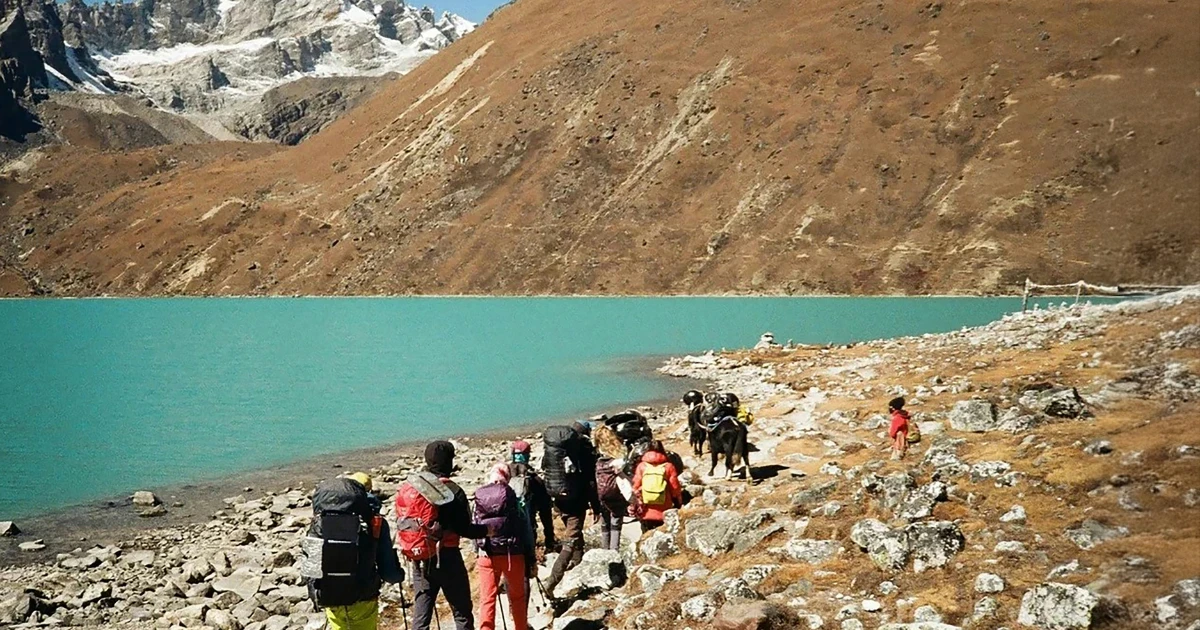
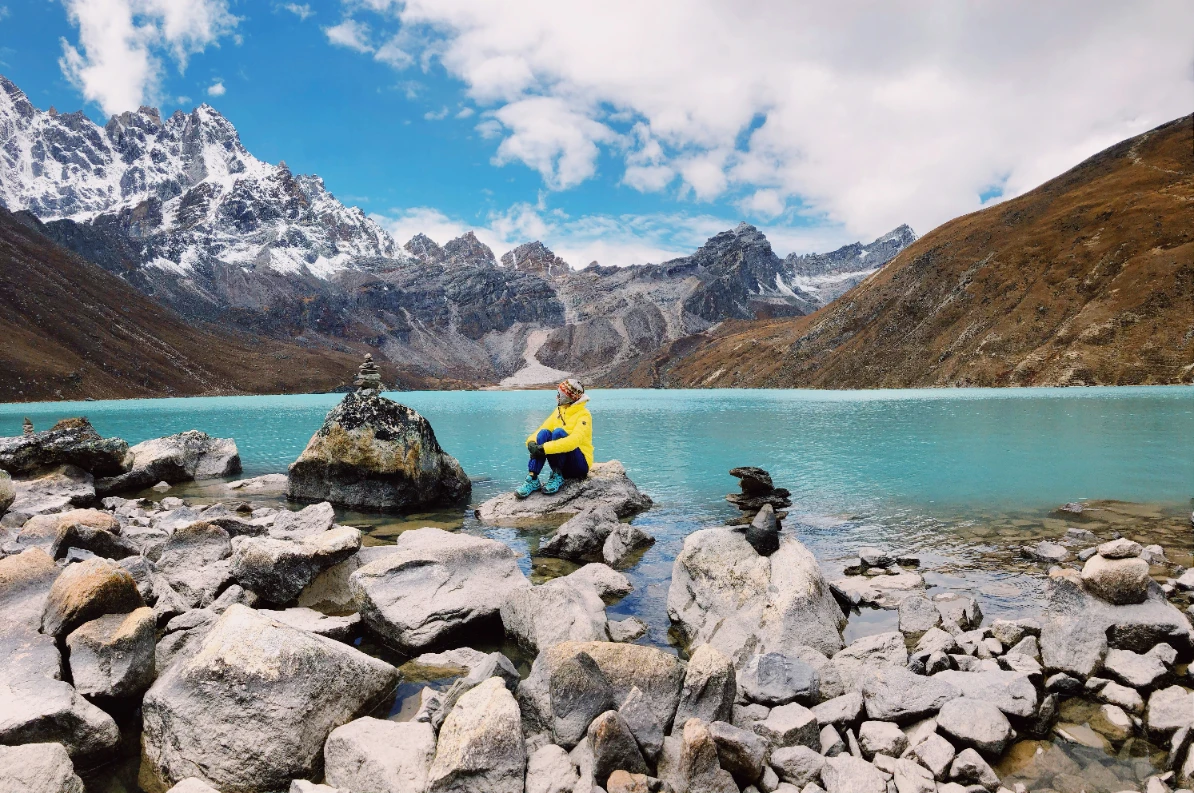
The rhododendron bloom on the Poon Hill approach peaks in mid-March at lower altitudes and late April at the highest elevation bands. The Mustang plateau is most spectacular in the post-monsoon clarity of late September and October, when the desert landscape is fresh-washed and the sky is an improbable blue. The Gokyo Lakes above the Everest Base Camp trail reflect the peaks most clearly in November, when the pre-dawn freeze reduces wind-induced surface movement. These windows are not available in a standard group departure calendar. They are the kind of timing optimisation that a private itinerary can be built around.
Hiking Nepal plans 2026 private departures against long-range weather modelling, real-time reports from guides already on the relevant trails, and historical meteorological data for each specific region. Clients are advised on optimal departure windows at the time of booking and updated if changing conditions make an adjustment beneficial.
Curated Travel: Elevating the Standard Teahouse Experience
The teahouse circuit is one of the great achievements of Himalayan trekking culture. Over decades, a network of family-run lodges has grown up along Nepal's major trekking routes, providing accommodation, food, and human warmth at altitudes where none of these things were available a generation ago. At their best, teahouses are extraordinary places: the smell of wood smoke and butter tea, the warmth of a shared dining room after a cold day, the conversations with other trekkers that begin over dinner and continue for days on the trail.
At their worst, they are damp, overcrowded, poorly ventilated, and serving food of indeterminate provenance to a dining room of forty people who all arrived on the same group departure. Both versions exist. The difference between them is selection.
Hand-Picked Boutique Lodges and Luxury Stays
Hiking Nepal maintains an active roster of preferred lodges on every private trek route, developed through years of direct relationship with owners and regular inspection visits. These are not necessarily the largest or the most recently built establishments. They are the lodges where the kitchen is clean, the bedding is changed between guests, the solar heating system is maintained, the water source is filtered and verified, and the owner considers guest experience a point of personal pride rather than a transaction.
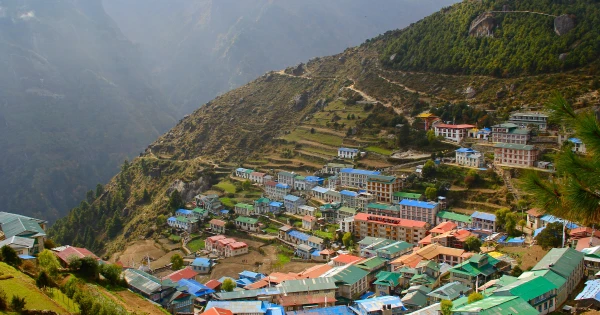
On routes where genuinely elevated accommodation exists, Hiking Nepal incorporates it into private itineraries as an option rather than an assumption. In the Everest corridor, the boutique lodges at Namche Bazaar and Phakding offer private rooms with attached bathrooms, reliable Wi-Fi, and menus that go considerably beyond the standard teahouse offering. In the lower Solukhumbu around the Pikey Peak circuit, a network of recently upgraded lodges offers heated rooms, en-suite bathrooms, and electric blankets at a standard that would be considered comfortable by European mountain hotel standards. In Pokhara and Kathmandu, Hiking Nepal works with a curated selection of boutique hotels ranging from heritage properties in Thamel to lakeside retreats that provide a genuine luxury base for the days before and after the trek.
For travellers seeking the highest accommodation standard currently available in Nepal's mountain regions, Hiking Nepal's 2026 luxury lodge programme incorporates the Yeti Mountain Home properties in the Khumbu, the Mountain Lodges of Nepal circuit in the Annapurna region, and a selection of private guesthouse arrangements in the Mustang and Tsum Valley corridors where commercial lodge infrastructure is less developed but family-hosted accommodation of exceptional warmth and quality is available.
Private Logistics: Arriving in Comfort and Style
The journey to the trailhead is, for most group trekkers, an afterthought. The crowded morning bus from Kathmandu to Besisahar. The four-hour delay at Ramechhap airport waiting for the Lukla weather window to open. The shared jeep that arrives an hour late and is now carrying three extra passengers on the roof rack. These are standard elements of the group trekking experience, and they set the tone for everything that follows.
Private trek logistics eliminate them. Every Hiking Nepal private departure uses a dedicated vehicle for ground transfers: a Toyota Land Cruiser or equivalent 4WD with reclining seats, a charged-up power bank, a cooler with drinks, and a driver who knows when to make the tea stop without being asked. Domestic flights are booked on the earliest available departure on the optimal day, with a confirmed booking rather than a standby place on the manifest. Helicopter options are available for approaches where the weather risk around standard domestic flights is significant, where the walking approach is more time than it is worth, or simply where the client prefers to arrive at the high altitude start point by the most direct and visually spectacular route available.
Helicopter Approaches and Returns
Helicopter access to Nepal's trekking regions has expanded substantially since 2020. Routes that once required four days of approach walking can now be accessed in 45 minutes from Kathmandu or 20 minutes from Pokhara. Helicopter options are particularly valuable for private trek clients with limited time, for travellers returning from high-altitude routes who prefer not to retrace the approach on foot, and for photographers who want to position themselves at altitude early in the morning for the best light without the previous day's walk compromising their energy for the shoot.
Hiking Nepal coordinates helicopter bookings through licensed operators on all major routes. Scenic routes over the Annapurna range, the Everest corridor, and the Langtang massif are available as standalone experiences or as integrated elements of a private trek itinerary. For the Pikey Peak luxury circuit, Hiking Nepal's signature departure includes a helicopter return from Phaplu to Kathmandu as the standard close to the trek rather than an upgrade.
Custom Nutrition and Dining on the Trail
Nutrition at altitude is not simply a matter of preference. The body's caloric requirements increase at elevation as it works harder to maintain core temperature and oxygenate the blood. Appetite, paradoxically, often decreases above 3,500 metres as a side effect of altitude adjustment. The result is a nutritional deficit that compounds fatigue, impairs recovery between walking days, and can accelerate the onset of altitude symptoms.
Hiking Nepal's private trek nutrition protocol starts with a detailed dietary brief collected at booking: dietary restrictions, allergies, preferences, and specific nutritional goals. This brief is communicated to every lodge on the route in advance. On private departures, the guide also carries a selection of supplementary trail nutrition, including high-calorie snacks, electrolyte sachets, specialist altitude nutrition bars, and emergency food rations for situations where the lodge kitchen cannot meet the brief.
For private departures on the luxury programme, Hiking Nepal works with specific lodges to offer menus beyond the standard teahouse range: organic local produce sourced from Sherpa farms in the lower Solukhumbu, fresh-ground coffee at altitude, speciality dietary accommodations for vegan and plant-based travellers, and culturally immersive dining experiences where dinner is cooked and served by the lodge family with narration from the guide about the provenance of each dish. On multi-day wilderness routes where teahouse stops are infrequent, Hiking Nepal's camping kitchen team can prepare full hot meals from a portable kitchen setup at any campsite on the route.
Tailoring the Himalayas for Every Type of Traveller
The idea that Himalayan trekking is a single activity with a single audience is one of the most limiting misconceptions in adventure travel. Nepal's geography, cultural diversity, altitude range, and route network are comprehensive enough to offer meaningfully different experiences to travellers with interests as distinct as wildlife photography, Tibetan Buddhist philosophy, culinary tourism, high-altitude endurance sport, and three-generation family adventure. What makes the private guided model indispensable for specialist travel is the ability to design an itinerary around the interest rather than bending the interest around the itinerary.
Photography-Focused Private Treks
Nepal offers some of the most technically extraordinary landscape and cultural photography in the world. The pre-dawn Himalayan light from Poon Hill at 3,210 metres. The golden hour on the Khumbu Icefall from Kalapatthar. The portrait opportunities in a Buddhist festival at Mani Rimdu in the Khumbu. The macro detail of rhododendron blooms in the Annapurna foothills. The architectural symmetry of a Newar temple courtyard in Bhaktapur. A single photography-focused private trek can include all of these within a carefully designed 14-day itinerary , if the itinerary is built around the photography, rather than the photography being fitted around the itinerary.
Hiking Nepal's photography trek programme is designed in consultation with the client's photographic interests and technical level. Departure and arrival times at each location are set around optimal light conditions rather than around logistical convenience. Rest days are placed at the most visually productive locations. The guide carries a working knowledge of each site's photographic potential, including seasonal variations in light direction, typical weather patterns at different times of day, and cultural event calendars that create portrait opportunities unavailable to travellers on standard routes.
For professional photographers and advanced amateurs, Hiking Nepal can arrange workshop formats in which a local photographer or guide with specialist knowledge of a specific cultural or landscape subject accompanies the trek for a portion of the itinerary, providing instruction and access that a standard guide cannot offer.
Spiritual and Meditation Retreat Treks
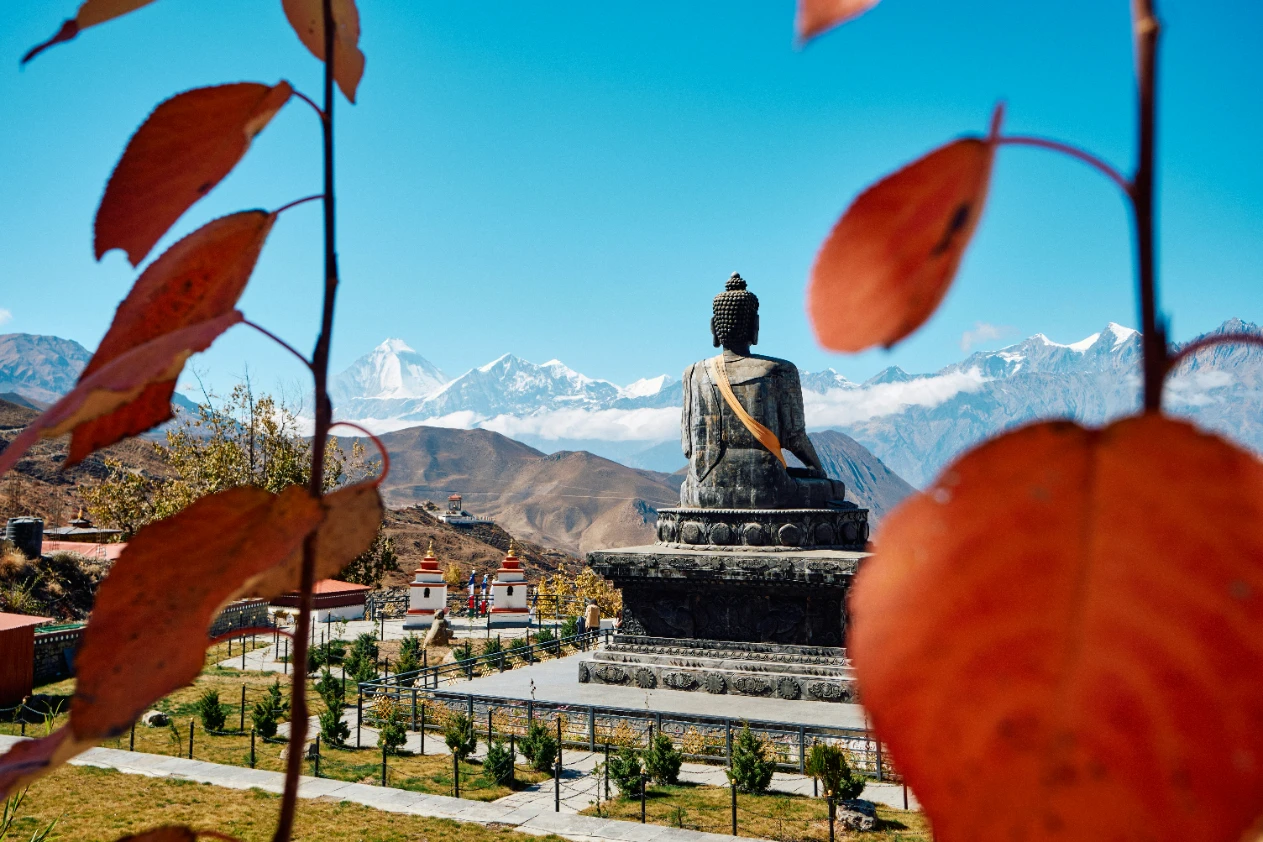
Nepal is one of the world's oldest and most continuously inhabited spiritual landscapes. The Annapurna and Mustang regions contain monasteries, hermitages, and sacred sites of the Nyingma, Kagyu, and Bon traditions that have been active for 800 to 1,200 years. The lower Solukhumbu is home to Thupten Choling, one of Nepal's most significant Nyingma monasteries, where the community of monks and nuns maintains a tradition of meditation instruction for qualified visitors. The Kathmandu Valley itself contains more UNESCO World Heritage spiritual sites within a ten-kilometre radius than almost any other location on earth.
A private spiritual trek can be designed to move between these sites with intention rather than passing them as sightseeing stops. Hiking Nepal works with specific monasteries to arrange teachings with senior lamas, meditation sessions in the main assembly hall, and in some cases, participation in morning prayer that goes beyond standard tourist access. The private guide's cultural and linguistic fluency is essential here: the difference between being shown a monastery and being welcomed into one is entirely relational, and it depends on the guide's existing relationships with the community.
Meditation retreat itineraries for Hiking Nepal's private programme are available in the Mustang region (centred on the Lo Manthang ancient city and the cave monasteries of the upper Kali Gandaki), the lower Solukhumbu (centred on Thupten Choling), and in the Kathmandu Valley for travellers who want spiritual depth without high-altitude trekking.
Family Adventures: Making the Mountains Accessible for Children
Family private trekking is the area of Hiking Nepal's portfolio that has grown most substantially in the past five years. The reasons are structural. A family of four with children aged eight and eleven cannot join a standard group departure and expect an experience calibrated to anyone in that family. The adults are undertrekked. The children are overtrekked. The guide is managing expectations across a group with wildly different needs. The entire dynamic works against the thing the family came for.
A private family departure runs on a completely different logic. The daily walking target is set around the youngest or least fit family member. The guide's relationship is with the children as much as the adults, and a skilled guide on a family departure is part motivator, part cultural translator, part safety officer, and part storyteller. Rest days are spent in ways the family actually wants to spend them rather than in ways that fit a group schedule. Dietary requirements are managed individually. The lodge selection accounts for family room availability, heated common areas, and menus that work for children.
Hiking Nepal's family private trek programme covers routes from the gentle cultural walks of the Kathmandu Valley and Pokhara surroundings through to the Poon Hill circuit and, for older children, the Annapurna Base Camp approach. Private family departures are available year-round, with dedicated family guides selected for communication skills with children as well as technical trekking competence.
Solo Travellers: Security and Companionship on the Trail
Solo trekking in Nepal carries a specific set of risks that group trekking distributes across the party. A solo trekker who develops altitude symptoms on a remote section of trail has nobody to go for help and nobody to monitor deterioration. A solo trekker who takes a wrong turn on a poorly marked junction in poor visibility has nobody to cross-check against. A solo trekker who is unfamiliar with the local cultural context may inadvertently cause offence or miss the meaning of an experience that would otherwise be transformative.
A private guide resolves all of these. For solo travellers, the private guide is simultaneously the safety net, the cultural companion, and the person who makes a genuinely solitary wilderness experience possible rather than merely survivable. Many of Hiking Nepal's most consistent repeat clients are solo travellers who tried the group experience first and have been booking private departures ever since.
The premium on a private departure for a solo traveller is the highest, in percentage terms, of any client profile. It is also, consistently, the one where the value assessment is most enthusiastic. The combination of undivided guide attention, total itinerary flexibility, and the deep personal connection that develops between a solo trekker and a dedicated guide over the course of a seven to fourteen-day journey is something that cannot be approximated in a group setting.
The High-End Explorer: Helicopter Camps and Wilderness Routes
At the furthest end of the private trek spectrum are itineraries that use Nepal's full logistical infrastructure to access locations that are simply not available through any other mechanism. The remote high camps above Mera Peak that require a helicopter approach and a fully kitted-out camping team. The Dolpo region in far western Nepal, accessible only by flight to Juphal and then a 10-day walk into one of the most geographically isolated inhabited valleys in the world. The Kangchenjunga Base Camp approach in far eastern Nepal, where the combination of very limited teahouse infrastructure and extraordinary wilderness photography makes a private camping trek the only viable format.
Hiking Nepal manages the full logistics for these advanced private expeditions: helicopter coordination, camping equipment supply and portering, advance permit applications for restricted areas, liaison with district authorities for remote-area security coordination, and satellite communication equipment for routes where mobile coverage is absent. The planning horizon for high-end remote itineraries is typically three to six months. For 2026 departures to restricted areas, Hiking Nepal recommends initiating contact no later than October 2025.
Specialist Interest Trekking: Routes Built Around What You Care About Most
One of the most distinctive capabilities of a well-run private guided trek operation is the ability to build itineraries around interests that cross the standard route categories. The following specialist programmes represent areas where Hiking Nepal has developed specific expertise and where the private guided format generates experiences unavailable on standard group itineraries.
Wildlife and Natural History Treks
Nepal's protected area network covers approximately 23 per cent of the country's land area and encompasses ecosystems ranging from subtropical lowland jungle to arctic-alpine desert above 5,000 metres. The Annapurna Conservation Area, the Sagarmatha National Park in the Khumbu, the Langtang National Park, and the remote Rara National Park in the far northwest all host wildlife and botanical communities of significant interest to natural history travellers.
Species of particular interest to private trek clients include the snow leopard (most reliably sighted in the Langtang and Manaslu corridor in winter months), the red panda (found in the rhododendron-oak forests of the middle Himalaya between 2,500 and 4,000 metres), the Himalayan tahr, the musk deer, and the extraordinary bird diversity that makes Nepal one of the top ten birding destinations in the world with more than 850 confirmed species.
Natural history private treks are planned around seasonal wildlife patterns, botanical bloom calendars, and birding windows, with a naturalist guide or specialist wildlife spotter accompanying the trekking guide on departures where species-specific expertise is required. Hiking Nepal works with a roster of specialist wildlife guides trained in the natural history of each major ecosystem, available as supplements to any private departure.
Culinary and Agricultural Heritage Treks
Nepali cuisine is the product of extraordinary ecological and cultural diversity. The rice-based agriculture of the middle hills, the buckwheat and barley cultivation of the high Himalaya, the yak dairy tradition of the Sherpa and Tibetan communities, the mustard oil cooking of the Newari kitchen, and the spiced vegetable and lentil traditions of the Terai lowlands together constitute a culinary landscape that is barely known outside Nepal and almost entirely absent from the international awareness that surrounds Himalayan trekking.
Hiking Nepal's culinary heritage trek programme visits the agricultural communities, farm kitchens, and market bazaars where this food culture is alive and practised. Participants cook with families in their homes, visit local markets with the guide to source ingredients, attend seasonal agricultural festivals if the timing aligns, and eat in settings that have nothing to do with the standard teahouse menu. This programme is currently available in the Kathmandu Valley, the lower Annapurna foothills around Ghandruk and Chhomrong, and in the Solukhumbu district of the Everest region.
High-Altitude Endurance Treks for Serious Athletes
For physically elite travellers , competitive trail runners, professional athletes, or experienced mountaineers seeking pre-acclimatisation for a technical climb , Hiking Nepal designs private itineraries built around performance rather than comfort. These routes push daily distances beyond the standard touring pace, incorporate technical terrain sections where appropriate, and are planned with an emphasis on altitude gain efficiency within safe acclimatisation parameters.
Routes in this category include the Everest Three Passes circuit (Renjo La 5,360m, Cho La 5,420m, Kongma La 5,535m), the Annapurna Circuit with Thorong La Pass (5,416m), the Mera Peak approach (6,476m, the highest trekking peak in Nepal), and the upper Mustang plateau. All high-altitude endurance itineraries include daily oxygen saturation monitoring, a pre-agreed descent protocol, and communication equipment appropriate to the remoteness of the route.
The Role of Expertise: What to Look for in a Private Trekking Partner
The quality of a private guided trek is inseparable from the quality of the guide. This is true of all guided travel, but it is especially true in a mountain environment where the stakes of a poor decision are higher than in a city tour. Choosing a private trekking operator in Nepal requires due diligence that goes beyond reading TripAdvisor reviews.
Guide Licensing and Safety Certifications
Nepal's trekking guide licensing system is administered by the Nepal Tourism Board and the Trekking Agencies Association of Nepal. A licensed trekking guide has completed a formal training programme covering trail navigation, altitude medicine, emergency first aid, and cultural heritage interpretation. A licensed high-altitude guide has completed additional training specific to routes above 5,000 metres.
Beyond licensing, the certifications that matter most for private trek safety are:
- Wilderness Advanced First Aid (WAFA) or Wilderness First Responder (WFR): internationally recognised emergency medicine training programmes designed for environments where evacuation is delayed. All Hiking Nepal private guides are WAFA-certified as a minimum standard.
- High Altitude Medicine training: specialist training in the recognition and management of AMS, HAPE, and HACE, typically delivered through the Himalayan Rescue Association or equivalent bodies.
- Technical mountaineering certification: required for guides accompanying clients on routes involving glacier travel or fixed rope sections, including Mera Peak and Island Peak approaches.
- Fluency in English and at least one additional language: practically relevant for clients who are not native English speakers and for guides working with culturally specific communities on route.
Experience in the Specific Region
Nepal's trekking regions are distinct enough that route-specific experience matters significantly. A guide with deep Khumbu knowledge may have limited familiarity with the Mustang plateau's access protocols, political sensitivities, and route network. A guide who knows the Annapurna Conservation Area intimately may not know the specific teahouse families and alternative trails that make the Tsum Valley experience exceptional.
When booking a private trek with Hiking Nepal, clients are matched with guides whose primary experience and ongoing working relationships are in the specific region of the planned itinerary. For multi-region itineraries, the approach is a lead guide with broad Nepal knowledge supported by a regional specialist for each distinct section of the route.
Cultural Competency and Language
The cultural dimension of Himalayan trekking is where the difference between an adequate guide and an exceptional one becomes most visible. A guide who speaks Nepali, English, and one or more Himalayan community languages (Sherpa, Tamang, Gurung, or Tibetan) has access to conversations, introductions, and cultural moments that a guide operating in English alone cannot approach.
More broadly, cultural competency in a guide means the ability to read a situation, facilitate an appropriate introduction, explain context without condescension, and navigate the space between tourist and community with respect and genuine knowledge. This is a qualitative skill developed over years of practice and cannot be verified from a brochure. Hiking Nepal's approach is to accompany guide selection with client testimonials from previous departures in the same region and to offer a pre-departure introduction between guide and client before the trek begins.
What Hiking Nepal's Private Trek Vetting Process Looks Like
Every guide working on Hiking Nepal private departures has been through a structured evaluation process: formal qualification verification, a guided practical assessment on relevant terrain, a cultural knowledge interview, and reference checks from previous private clients. Annual performance reviews are conducted on the basis of client feedback and a formal assessment by the Hiking Nepal operations team.
Porters on private departures are contracted rather than freelance-hired at the trailhead, receive a written employment agreement, are paid above the Annapurna and Sagarmatha porter welfare standards, and are provided with appropriate equipment for the altitude and season of the route. Hiking Nepal's porter welfare protocol is aligned with the International Porter Protection Group (IPPG) standards.
Health and Safety Protocols on Private Guided Treks
The safety architecture of a private guided trek goes beyond what any group departure can practically offer. It is one of the most compelling practical arguments for private travel in a mountain environment, and it deserves to be understood in specific rather than general terms.
Pre-Trek Health Assessment and Medical Clearance
Before any private departure above 3,500 metres, Hiking Nepal requests completion of a health declaration covering relevant medical history, current medications, previous altitude experience, and any recent changes in health status. For clients with cardiovascular conditions, respiratory issues, or a history of altitude illness, consultation with a travel medicine physician is recommended before booking is confirmed. Hiking Nepal's operations team can provide a medical information pack for GP and specialist review on request.
Pre-trek fitness preparation guidelines are provided at booking for all private clients. These are not generic advice. They are specific recommendations based on the planned itinerary, the client's stated fitness level, and the altitude profile of the route.
On-Trail Safety Equipment
Every Hiking Nepal private departure carries the following as standard equipment:
- Calibrated pulse oximeters (minimum two, one carried by the guide, one in the main kit bag) for twice-daily oxygen saturation monitoring.
- A portable altitude chamber (Gamow bag) on all routes above 4,000 metres with overnight stays , a pressurisation bag that can simulate the physiological effects of descending 1,500 metres without moving the patient.
- Supplemental oxygen with a regulator and appropriate masks, carried from 3,000 metres upwards on all private departures.
- Comprehensive first-aid kit including altitude medication (dexamethasone for HACE, nifedipine for HAPE, acetazolamide for AMS), wound management supplies, blister treatment, and rehydration materials.
- Satellite communication device on all routes above 3,500 metres or in areas with unreliable mobile coverage, providing two-way messaging and SOS capability.
- A written emergency action plan for the specific route, covering the nearest evacuation point from each overnight stop, helicopter landing zones, and the protocol for contacting Hiking Nepal's 24-hour emergency coordination team.
Medical Evacuation and Insurance
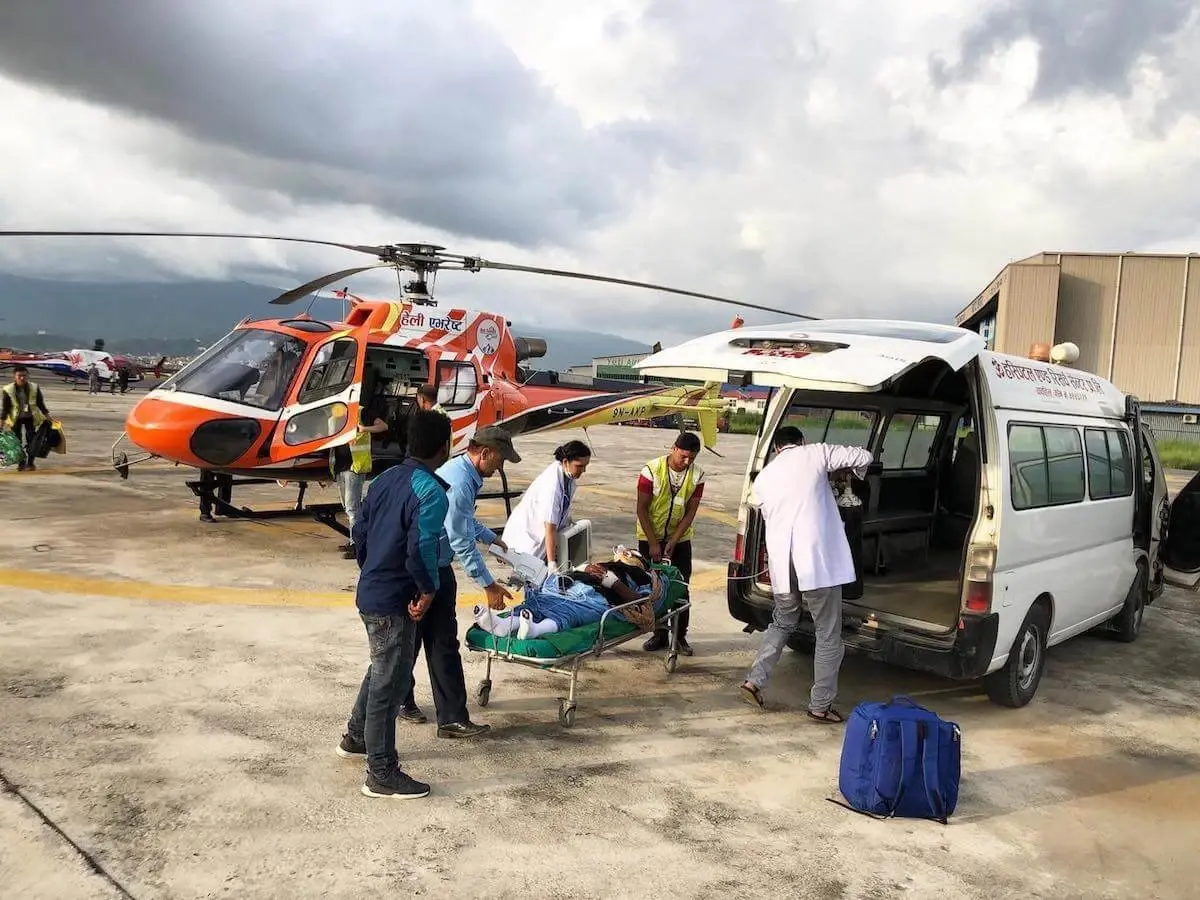
Helicopter medical evacuation is the standard emergency response for serious altitude illness in Nepal and can be arranged from most major trekking routes within one to three hours of a distress call under good weather conditions. The cost of helicopter evacuation ranges from USD 1,500 to USD 4,000 depending on the location and the operator, and is covered by standard adventure travel insurance policies that include emergency evacuation.
Hiking Nepal verifies travel insurance documentation for all private clients at the pre-trek briefing. Policies must explicitly cover helicopter evacuation from altitude, emergency medical treatment, and repatriation. Standard travel insurance from high-street providers frequently excludes trekking above 2,000 metres. Specialist adventure travel policies (World Nomads, True Traveller, BUPA Adventure, and similar providers) include the necessary coverage. Hiking Nepal's operations team can advise on appropriate policy specifications for any planned itinerary.
Beyond evacuation insurance, Hiking Nepal maintains a 24-hour emergency coordination service throughout the trekking season. This service manages communication between the guide, the helicopter operator, the receiving hospital in Kathmandu, and the client's family or emergency contact. It is a resource that private clients can rely on without the bureaucratic complexity of managing an emergency in an unfamiliar system while simultaneously dealing with a health crisis.
Sustainable Bespoke Travel: Protecting the Nepal You Love
Private guided trekking carries an inherent tension. The intimacy and depth of the experience depends on accessing places, communities, and natural environments of exceptional quality. The act of accessing them, if managed badly, degrades the very qualities that make them exceptional. This is the central sustainability challenge of Himalayan tourism, and it is not resolved by simply charging more for the experience.
Where Tourism Revenue Goes and Why It Matters
Nepal's trekking industry generated approximately NPR 58 billion in direct tourism revenue in the 2023 to 2024 fiscal year, according to Nepal Tourism Board figures. The geographic distribution of this revenue is deeply uneven. The Everest Base Camp corridor, the Annapurna Circuit, and the Poon Hill route account for the majority of trekking visitor volume and the majority of trekking revenue. Regions that are equally or more spectacular in natural terms, but off the standard group tour map, receive a fraction of the benefit.
Private guided trekking with a thoughtful operator redistributes this revenue in two directions. First, the use of lower-traffic routes channels spending into communities that are currently bypassed by the mainstream trekking economy. A private departure to the Tsum Valley, the Nar Phu corridor, or the lower Solukhumbu brings permit fees, lodge revenue, porter employment, and guide income to communities that see very few international visitors. Second, the quality of the client relationship in a private setting creates a different kind of traveller investment in the destination. Clients who have had a genuine, relationship-based experience in a Nepali community are statistically more likely to return, more likely to bring others, and more likely to make specific donations to the communities they visited. The depth of the experience drives the breadth of the benefit.
Fair Pay, Porter Welfare, and Ethical Employment
The treatment of porters is the most visible and the most frequently discussed ethical issue in the Nepal trekking industry. A porter carrying a 30-kilogram load at 4,000 metres in inadequate clothing and footwear, paid less than USD 8 per day and excluded from the lodge accommodation that the trekkers sleep in, is not a background detail of an otherwise ethical trip. It is the central ethical fact of it.
Hiking Nepal's porter welfare standards exceed the International Porter Protection Group minimum benchmarks on every metric. All porters are contracted (not freelance-hired at the trailhead), receive a written employment agreement in Nepali, are paid a daily rate meeting or exceeding the regional IPPG minimum, are provided with altitude-appropriate clothing and sleeping gear for the route's conditions, and eat and sleep in the same teahouses as the clients and guide. Load limits are enforced. No Hiking Nepal porter carries more than 20 kilograms. Porters who request rest days or report physical complaints are relieved without penalty.
This is not charity. It is the operating standard that Hiking Nepal believes the industry should apply universally, and it is the standard that clients booking private departures can verify and hold us to. On request, Hiking Nepal provides a porter welfare statement for any specific departure confirming the employment terms, load weight, accommodation arrangements, and insurance coverage for every porter on the trek.
Eco-Friendly Trekking Practices on Private Departures
Private trek clients generate a measurable physical footprint on the routes they travel. Hiking Nepal's environmental protocol for private departures addresses this across the full itinerary.
Plastic elimination: all Hiking Nepal private clients receive a stainless-steel reusable water bottle before departure. Lodges on our preferred networks are briefed to provide filtered water refills rather than single-use plastic bottles. Where water quality is uncertain, guide-carried purification tablets are used rather than bottled water.
- Waste management: all non-biodegradable waste generated on a private trek is carried out of the protected area by the porter team and disposed of at the first managed waste facility below the trekking zone. Hiking Nepal does not leave waste at altitude disposal points that are already at capacity.
- Firewood discipline: Hiking Nepal's private departures do not use firewood for cooking or heating, using gas or solar heating systems at every lodge. On camping routes, a portable gas kitchen is standard kit. This is a small but non-trivial contribution to reducing the deforestation pressure that remains significant on the most heavily trafficked trekking corridors.
- Conservation Area contribution: a portion of the fee for every Hiking Nepal private departure is allocated to a conservation contribution beyond the mandatory permit fees. In 2026, this contribution supports the Annapurna Conservation Area Programme's community forestry initiative and the Sagarmatha Pollution Control Committee's waste management operations in the Khumbu.
The Responsible Travel Pledge
Every Hiking Nepal private client receives, at pre-trek briefing, a responsible travel guide covering community interaction etiquette, appropriate photography practice, cultural respect protocols, and the environmental commitments the company makes on their behalf. This document is not a legal disclaimer. It is a conversation starter about what it means to travel responsibly in Nepal and what the client can do, beyond choosing the right operator, to ensure their presence in these communities leaves a positive rather than a neutral trace.
Private Trek Pricing: Understanding What You Are Paying For
The cost of a private guided trek in Nepal is the question most frequently asked and the one that requires the most contextualised answer. A quoted daily rate without context is nearly meaningless: it does not tell you whether the guide is licensed, whether the porter is contracted or freelance, whether the lodge selection is inspected or arbitrary, whether the safety equipment is current or nominal, or whether the company has genuine operational presence in the region.
The following structure reflects Hiking Nepal's 2026 pricing for private guided departures across the main programme categories. These prices are not the cheapest available. They reflect the actual cost of operating at the standards described in this guide.
2026 Private Trek Pricing
Programme | Duration | From (USD per person) | Notes |
| Cultural valley walks (Kathmandu, Pokhara surrounds) | 1 to 3 days | $180 per day | Licensed guide, vehicle, all logistics |
| Short luxury circuits (Poon Hill, Pikey Peak) | 5 to 7 days | $420 to $680 per person | All inclusive, selected lodges |
| Classic high routes (EBC, ABC, Langtang) | 10 to 16 days | $950 to $1,600 per person | All inclusive, WAFA guide |
| Restricted area permits (Mustang, Tsum, Nar Phu) | 12 to 20 days | $1,800 to $3,200 per person | Permit fees, specialist guide |
| Luxury lodge programme (Khumbu, Annapurna) | 10 to 14 days | $2,800 to $4,500 per person | Boutique lodges, helicopter option |
| Remote wilderness and camping (Dolpo, Kangchenjunga) | 14 to 22 days | $3,500 to $6,000 per person | Full expedition support |
| Helicopter expeditions (Everest, Annapurna overflights) | 1 to 5 days | $800 to $2,200 per person | Scenic flights plus ground programme
|
All Hiking Nepal private trek prices include licensed guide, contracted porter allocation, hand-selected accommodation, all meals on trek, relevant permit fees, private ground transfers, pulse oximeter monitoring, supplemental oxygen, and 24-hour emergency coordination. International flights and travel insurance are not included. Tipping for guides and porters is customary and gratefully received.
Frequently Asked Questions: Private Guided Treks in Nepal
What is the difference between a private guided trek and a solo trek with a guide?
A solo trek with a guide typically refers to an independent traveller hiring a single guide, often informally at the trailhead, without the backing of an agency, a pre-arranged itinerary, or any operational support structure. A private guided trek with an operator like Hiking Nepal includes full pre-trip itinerary design, safety protocol documentation, permit arrangement, accommodation pre-booking, porter welfare management, insurance verification, emergency coordination, and a guide whose employment and qualifications have been vetted and who is accountable to the operating company. The guide is the same in both scenarios. Everything around the guide is entirely different.
How far in advance do I need to book a private trek in Nepal?
For standard itineraries in the main trekking corridors, six to eight weeks is typically sufficient. For departures in restricted permit areas (Mustang, Tsum Valley, Nar Phu, Dolpo), where permit quotas apply and advance applications are required, a minimum of three to four months is recommended. For peak season departures in March, April, October, and November on routes with limited luxury lodge availability, three months is also advisable for accommodation-sensitive itineraries. Hiking Nepal accepts enquiries up to 12 months in advance and can hold provisional itineraries for 14 days while insurance and flights are arranged.
Can a private itinerary be changed once the trek has started?
Yes. This is one of the defining advantages of private over group travel. A private itinerary is a plan, not a contract. If conditions change (weather, health, new opportunity), the guide has operational authority to adjust the day's plan, add or remove overnight stops, and re-route around obstacles. Significant changes, such as switching from a high-altitude route to a lower alternative or adding a helicopter section, are communicated to the Hiking Nepal operations team and managed centrally. The client is never locked into a plan that is no longer serving them.
Is a private guided trek suitable for someone who has never trekked before?
Completely. A first-time trekker is, in many ways, the ideal private trek client, because the guide's attention is not shared with more experienced trekkers who set an aggressive pace. The itinerary is designed around the client's actual fitness level rather than an assumed average. The pre-trek briefing is more thorough and the on-trail instruction covers walking technique, altitude awareness, hydration discipline, and cultural etiquette in a way that a group tour simply cannot accommodate. Many of Hiking Nepal's most enthusiastic reviews come from first-time trekkers who chose the private format and discovered that their experience of the Himalayas bore no resemblance to the intimidating version they had imagined.
What is the best private trek in Nepal for a first-time visitor?
The answer depends on available time and fitness level, but the three most recommended first-time private trek itineraries are: the 5-day Poon Hill luxury circuit for travellers with limited time who want a complete Himalayan experience at accessible altitude; the 10-day Langtang Valley private trek for travellers who want high-altitude forest, Tamang cultural depth, and a less crowded alternative to the standard routes; and the 12-day Everest Base Camp private trek for travellers whose bucket list specifically includes the Khumbu. All three are available as private departures year-round, with luxury lodge options on the Poon Hill and EBC routes.
How do I know if the guide Hiking Nepal assigns is the right fit for me?
Hiking Nepal offers a pre-departure introduction between every private client and their assigned guide before the trek begins. This typically takes the form of a video call or an in-person meeting in Kathmandu, during which the client can ask specific questions, verify the guide's experience in the planned region, and assess the personal dynamic. If the fit is not right, a different guide assignment is arranged without question. This process exists because Hiking Nepal understands that a private trek is, fundamentally, a partnership, and that partnership needs to work from Day 1.
Hiking Nepal's Signature Private Trek Routes for 2026
The following selection represents Hiking Nepal's curated programme of private departures across Nepal's main trekking regions. Each route is available as a fully private, fully customised departure on any date throughout the trekking season.
Route | Region | Duration | Max Altitude | Signature Feature |
| Poon Hill Luxury Circuit | Annapurna foothills | 5 to 7 days | 3,210m | Hillary's Everest panorama, rhododendron forest, Gurung culture |
| Pikey Peak Luxury Trek | Lower Solukhumbu | 7 to 10 days | 4,065m | Sir Edmund Hillary's preferred Everest viewpoint, zero crowds |
| Everest Base Camp Private | Khumbu, Sagarmatha | 12 to 14 days | 5,364m | Sherpa culture, Khumbu Icefall views, Namche Bazaar |
| Annapurna Base Camp Private | Annapurna Sanctuary | 10 to 12 days | 4,130m | Natural amphitheatre of 8,000m peaks, Gurung villages |
| Langtang Valley Private | Langtang National Park | 8 to 10 days | 4,984m | Tamang heritage, glacial lakes, quiet trails |
| Mustang Plateau Private | Upper Mustang (restricted) | 14 to 16 days | 3,840m | Tibetan Buddhist culture, cave monasteries, Lo Manthang walled city |
| Tsum Valley Private | Manaslu Conservation Area | 14 to 18 days | 3,700m | One of Nepal's most sacred valleys, ancient monastery stays |
| Nar Phu Valley Private | Annapurna Conservation Area (restricted) | 16 to 20 days | 5,320m | Virtually untouched Tibetan community, high-altitude wilderness |
| Kangchenjunga Base Camp | Far eastern Nepal | 18 to 22 days | 5,143m | Third-highest mountain, complete wilderness, endemic wildlife |
| Dolpo Wilderness Trek | Far western Nepal | 18 to 24 days | 5,360m | One of Nepal's last genuinely remote destinations, Bon culture |
Every route in this programme is available as a private departure with full itinerary customisation, guide matching, luxury lodge selection where available, and the complete Hiking Nepal safety and support framework. Routes marked as restricted require advance permit applications. Contact Hiking Nepal for a personalised itinerary and pricing proposal for any route above.
Start Planning Your Curated Himalayan Trips
Nepal will take your breath away in more than one sense. At altitude, the thin air and the physical demand of the terrain create an unavoidable intimacy with your own body and its limits. At the cultural level, the depth and continuity of the traditions you encounter along the way create an equally unavoidable intimacy with a way of being in the world that is genuinely different from anything available in the countries most international travellers come from.
A private guided trek is the mechanism for experiencing both of these things at full intensity, without the dilutions and compromises of the group format. It is not a luxury in the sense of being unnecessary. It is a luxury in the truest sense: the luxury of doing exactly what you came here to do, at exactly the pace that works for you, with someone beside you who understands the landscape you are moving through and the culture you are moving within.
That is what Hiking Nepal has been building towards since we guided our first private departure. Every guide we have trained, every lodge relationship we have developed, every safety protocol we have written, and every itinerary we have designed has been in service of the same thing: getting you to the Nepal that exists beyond the standard itinerary and making sure you come back safely from it.
Spring 2026 private departure dates are open for booking. Autumn 2026 restricted area permit applications close in June for October and November departures. Contact the Hiking Nepal team to begin your itinerary consultation.