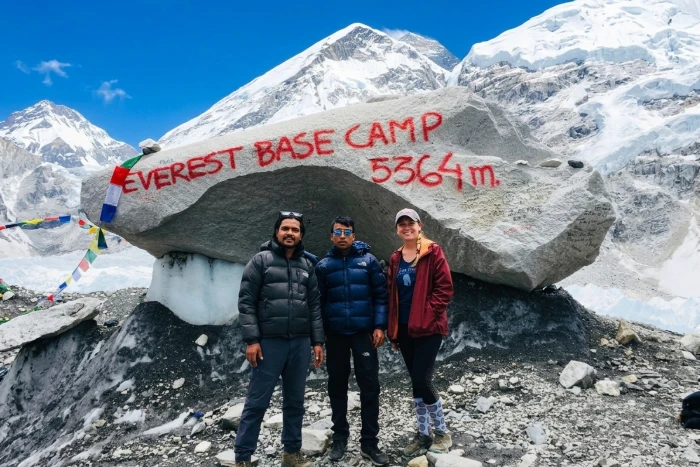
Most people arrive in Nepal with more ambition than time. The Everest Base Camp trek takes a minimum of 14 days. The Annapurna Circuit takes sixteen. The Manaslu Circuit takes fifteen. These are extraordinary routes and every one of them is worth the commitment, but if you have a week or less, they are simply not available to you.
What is available to you is more impressive than most people realise before they start looking.
Nepal's short trek network covers routes that reach genuine high-altitude Himalayan viewpoints, pass through living Sherpa and Gurung villages, cross suspension bridges above glacial rivers, and deliver the specific quality of morning light on a 7,000-metre peak that people fly halfway around the world to experience. Several of these routes can be started the day after you land. None of them require mountaineering experience. Some require no prior trekking experience at all.
This guide covers the best short treks in Nepal for 2027, with practical information on each route's difficulty, duration, cost, permits, best season, and what to expect on the trail. It is written for two kinds of reader: the beginner who wants to understand what a first Nepal trek looks like in practice, and the experienced traveller with a tight schedule who wants to make a short window count.
What Counts as a Short Trek in Nepal?
For this guide, a short trek is any circuit or out-and-back route completable in one to seven days from the nearest city or transport hub, without requiring a domestic flight to reach the trailhead, and without technical climbing or specialist equipment. Most of the routes below sit within this definition comfortably. A few stretch to seven days at a comfortable pace and can be shortened to five with a faster approach.
Short does not mean easy. Several routes below involve steep ascents, cold pre-dawn summit starts, and nights at altitude that require proper warm clothing. The altitude ceiling for a short trek in Nepal ranges from 1,600 metres on the most accessible day walks to 3,210 metres on the Poon Hill viewpoint to 4,130 metres on the Mardi Himal approach. The experience scales accordingly.
Why Short Treks Work Particularly Well in Nepal
Nepal's geography is unusually favourable for short-duration trekking. The Annapurna and Langtang ranges begin rising steeply from valley floors that are within a few hours of Pokhara and Kathmandu respectively, which means altitude gain begins almost immediately after leaving the city rather than after several days of approach walking through lowland terrain.
The teahouse infrastructure, built up over decades of trekking tourism, supports short routes as well as long ones. Every circuit described in this guide has clean, heated teahouse accommodation at each overnight stop, a varied menu, and the basic facilities, hot showers, battery charging, and filtered water, that make a trek comfortable rather than an endurance exercise.
The permit and logistics system for short treks is also straightforward. Most routes require only a TIMS card and an ACAP or national park permit, both available on the same day in Kathmandu or Pokhara. No restricted area permits are needed for any of the routes below. No domestic flights are required for trailhead access.
The Best Short Treks in Nepal for 2027
Poon Hill Trek
Duration: 4 to 5 days Maximum altitude: 3,210m Difficulty: Easy to moderate Trailhead access: 90 minutes by jeep from Pokhara Best season: Mid-March to May, October to November Permits: TIMS card (NPR 2,000) and ACAP permit (NPR 3,000)
The Poon Hill circuit is the most popular short trek in Nepal and it holds that position for straightforward reasons. It is accessible, logistically simple, culturally engaging, and it delivers a dawn panorama from 3,210 metres that includes Dhaulagiri, Annapurna South, Machhapuchhre, and Annapurna I in a single uninterrupted sweep. For a first Nepal trek, it covers every essential element of what Himalayan trekking offers without the duration, altitude, or logistical complexity of the major circuits.
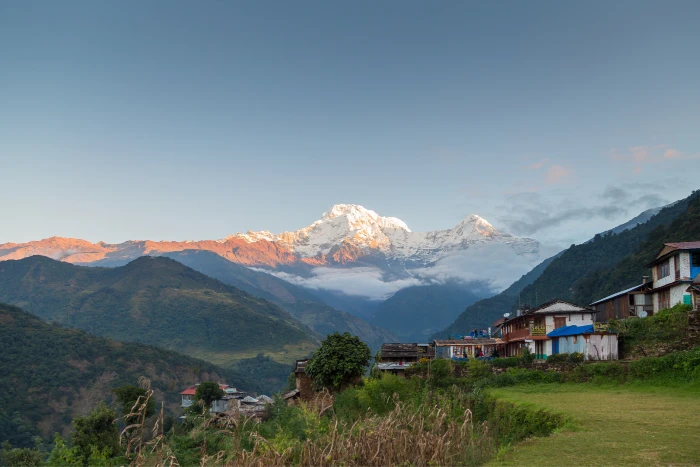
The standard four-day route starts at Nayapul, a 90-minute drive from Pokhara, and climbs through the Gurung villages of Tikhedhunga and Ulleri to Ghorepani at 2,860 metres before the pre-dawn summit walk to Poon Hill. The descent goes via Tadapani and Ghandruk, two of the most architecturally intact Gurung villages in the Annapurna foothills, before dropping back to the road at Nayapul.
The hardest section is the stone staircase from Tikhedhunga to Ulleri on Day 2: approximately 3,000 steps over 90 minutes of sustained uphill. Start this section early, before the morning heat builds, and it is entirely manageable for any reasonably fit adult. The rest of the circuit is moderate walking through forest and terraced farmland with no sections that require special technique or equipment.
In spring from mid-March through April, the rhododendron forest between Tikhedhunga and Ghorepani blooms in successive waves of red, pink, and white at different altitude bands. This is worth seeing and is the main reason spring is the premium departure window for this route. Hiking Nepal's spring 2027 Poon Hill departures run from mid-March through early May. Peak dates in late March and early April book out several weeks in advance.
The Poon Hill circuit suits: first-time Himalayan trekkers, families with children aged seven and above, travellers with five days or fewer, and anyone who wants a complete Himalayan experience including summit sunrise, Gurung culture, and rhododendron forest in one short circuit.
Ghorepani Poon Hill Extended Loop
Duration: 5 to 7 days Maximum altitude: 3,210m Difficulty: Easy to moderate Trailhead access: 90 minutes by jeep from Pokhara Best season: Mid-March to May, October to November Permits: TIMS card and ACAP permit
The extended Ghorepani loop takes the standard Poon Hill circuit and adds the Tadapani to Ghandruk to Chhomrong section, giving the route a deeper cultural dimension and a more complete sense of the lower Annapurna region rather than a quick summit-and-return. The maximum altitude is the same as the standard Poon Hill circuit at 3,210 metres, but the additional two days substantially increase the cultural content of the trek.
Ghandruk, the largest Gurung village on the circuit, is the highlight of the extension. The Gurung Heritage Museum in the village centre covers traditional tools, clothing, and cultural history in a restored traditional house. The village architecture of flat-roofed stone buildings arranged on a south-facing slope above the Modi Khola valley is among the most visually distinctive in the Annapurna foothills. A full afternoon in Ghandruk, including a weaving demonstration at a household loom and a walk through the village lanes with your guide, adds a dimension to the trek that the faster circuit omits.
The 7-day version of this loop is the recommended structure for families, for mixed-fitness groups, and for anyone who wants the Poon Hill sunrise within a more expansive experience of the region.
Mardi Himal Trek
Duration: 5 to 7 days Maximum altitude: 4,500m (High Camp) to 4,900m (optional viewpoint) Difficulty: Moderate Trailhead access: 30 minutes by taxi from Pokhara to Kande Best season: March to May, October to November Permits: TIMS card and ACAP permit
Mardi Himal sits directly east of the Annapurna Base Camp trail and is one of the least visited routes in the Annapurna Conservation Area despite being one of the closest to Pokhara. This makes it the short trek of choice for travellers who have already done Poon Hill and want more altitude, more solitude, and a different angle on the Annapurna range.
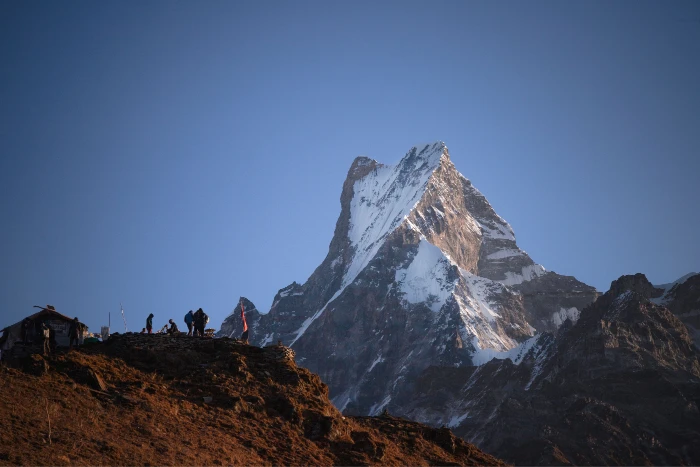
The route climbs from Kande at 1,770 metres through dense forest to the Forest Camp and Low Camp before ascending to High Camp at 3,580 metres and an optional viewpoint push to the Mardi Himal Base Camp ridge at approximately 4,500 metres. The view from the upper section is a direct, close-range perspective on Machhapuchhre (Fishtail Peak) at 6,993 metres from the east face, a view that is not available from Poon Hill or any other short circuit near Pokhara.
The trail above Forest Camp becomes less developed and requires more navigational attention than the Poon Hill circuit, which is part of the route's appeal for trekkers wanting something more independent in character. An experienced guide is strongly recommended. Trail markings are inconsistent above Low Camp and the route passes through forest sections where multiple paths converge without clear indication of the correct line.
The altitude at High Camp, 3,580 metres, and the viewpoint at 4,500 metres places this route at the upper end of the short trek altitude range and means AMS awareness is relevant. The ascent profile is gradual enough that most fit adults acclimatise well, but an extra night at Forest Camp rather than pushing to High Camp in one day is advisable for anyone who has not trekked above 3,000 metres before.
The Mardi Himal trek suits: trekkers with prior experience on easier circuits who want more altitude and solitude, travellers who specifically want a close view of Machhapuchhre, and those who want a genuine wilderness character without the crowd density of the Poon Hill or Annapurna Base Camp approaches.
Annapurna Base Camp Short Trek
Duration: 7 to 9 days Maximum altitude: 4,130m Difficulty: Moderate Trailhead access: 90 minutes by jeep from Pokhara to Nayapul or Hile Best season: March to May, October to November Permits: TIMS card and ACAP permit
The Annapurna Base Camp trek sits at the longer end of the short trek category at seven to nine days, but it belongs in this guide because it remains one of the most time-efficient ways to reach a genuinely iconic Himalayan destination. The Annapurna Sanctuary at 4,130 metres is a natural amphitheatre ringed by seven peaks above 6,000 metres, including Annapurna I at 8,091 metres and Machhapuchhre, and the overnight stop at base camp puts you inside that amphitheatre rather than looking at it from a distance.
The direct approach from Hile or Nayapul via Chhomrong, Bamboo, and Deurali covers the route in nine days at a comfortable pace. For trekkers with seven days available and a good fitness baseline, Hiking Nepal runs a seven-day express version that moves faster on the lower sections. Neither version requires technical skills but both demand several consecutive days of six to seven hours of walking at altitudes above 3,000 metres. This is not the right first trek for a beginner, but it is within range for any reasonably active adult who has done at least one multi-day hill walk in the past year.
Altitude management is more relevant on the ABC trek than on Poon Hill or Mardi Himal. The overnight stop at Machhapuchhre Base Camp at 3,700 metres before ascending to ABC is a standard part of the acclimatisation structure. Moving too fast through this section is the most common cause of altitude-related problems on the route.
The Annapurna Base Camp trek suits: fit travellers with one week available who want a significant altitude objective, trekkers with prior experience on shorter routes who are ready for a more serious commitment, and anyone for whom Annapurna Base Camp specifically is on the list and one week is all the time available.
Australian Camp and Dhampus Trek
Duration: 2 to 3 days Maximum altitude: 2,065m Difficulty: Very easy Trailhead access: 30 minutes by taxi from Pokhara to Kande or Phedi Best season: Year-round except heavy monsoon Permits: TIMS card only
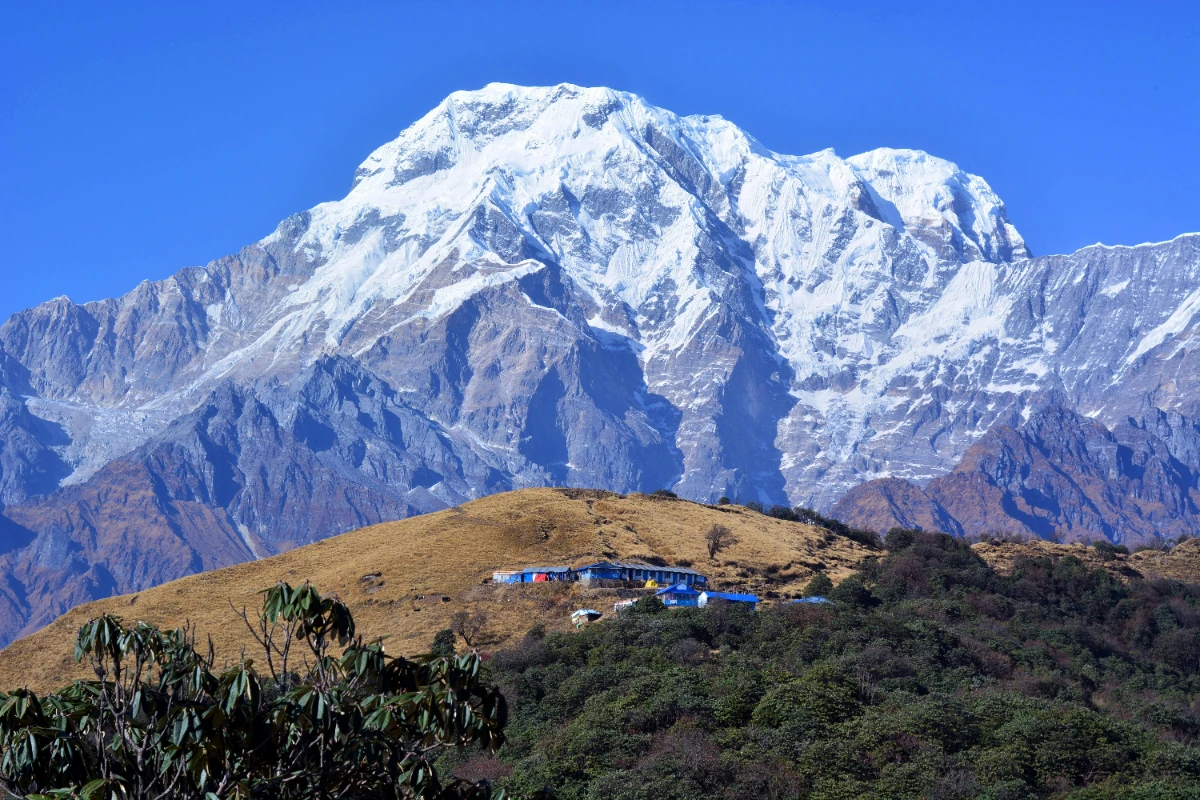
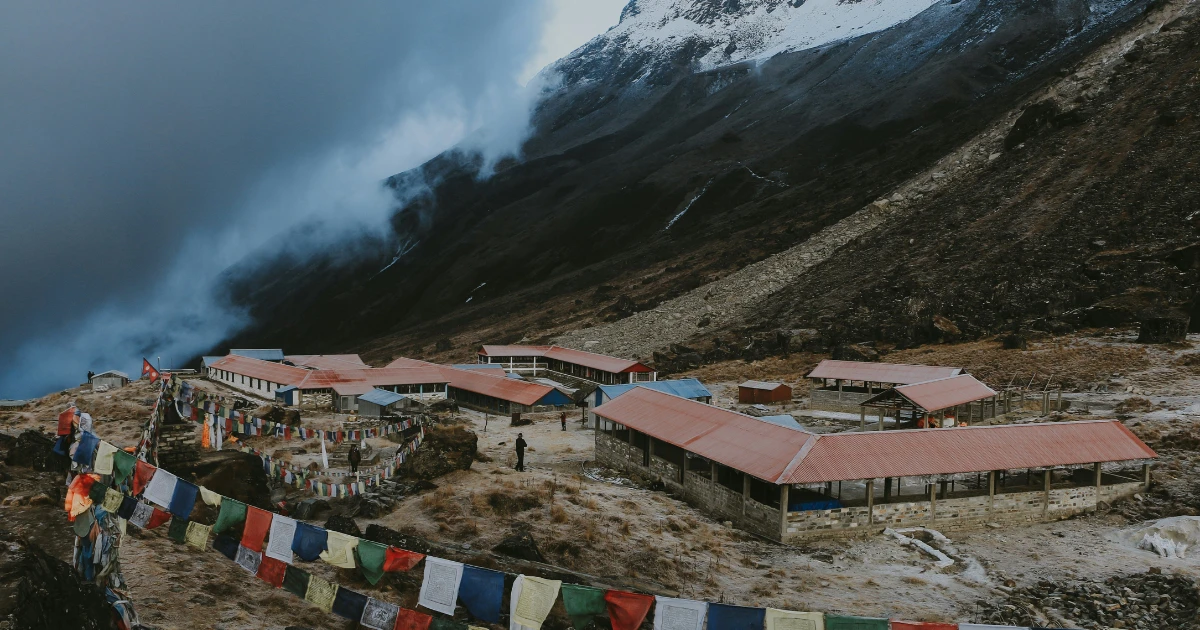
Australian Camp is where Pokhara's geographical advantage is most immediate. The trailhead at Kande is 30 minutes from Lakeside. The walk from Kande to Australian Camp at 2,065 metres takes three to four hours on a well-maintained path through forest and small settlements. The view from the ridge is a direct line of sight to Annapurna South, Hiunchuli, Machhapuchhre, and Annapurna I.
This is the right trek for travellers with one or two days in Pokhara who want a genuine mountain view without a multi-day commitment, for families with young children, and for first-time Nepal visitors who want to test their legs and equipment before a longer circuit. The teahouse accommodation at the camp is simple but adequate. Sunrise from the ridge on a clear morning is the defining moment of the trek.
The Dhampus extension adds one day and descends through one of the most culturally intact Gurung villages accessible on a short walk from Pokhara. Dhampus at 1,650 metres has traditional stone houses, a working community of farmers and yak herders, and the option of a homestay with a Gurung family that provides a direct, authentic cultural experience unavailable on the more developed circuits.
The Australian Camp and Dhampus trek suits: travellers with one to three days available, families with children aged five and above, first-time Nepal visitors, and anyone who wants a cultural village experience alongside mountain views without altitude risk.
Sarangkot
Duration: 1 day Maximum altitude: 1,600m Difficulty: Very easy Trailhead access: 20 minutes by taxi from Pokhara Best season: Year-round Permits: None required
Sarangkot is a 45-minute walk from the road at the base of the hill to the viewpoint at 1,600 metres. It is not a trekking circuit in the conventional sense, but for a traveller with a single morning in Pokhara it is the most efficient use of that morning available anywhere in the region.
The pre-dawn taxi from Lakeside, arriving at the base of the hill at 5:15 am, gets you to the viewpoint before the light arrives. The panorama north and northeast takes in the full Annapurna chain, Dhaulagiri, and Machhapuchhre above the Pokhara valley. In spring with rhododendron-covered hills in the foreground, it is genuinely beautiful.
Sarangkot is also the main paragliding launch point for the Pokhara valley, with tandem flights available from the viewpoint throughout the morning between NPR 8,000 and NPR 12,000. The combination of the sunrise walk and a morning paragliding flight over Phewa Lake, landing on the shore below Lakeside, makes for one of the better single days available from any Nepal base city.
Langtang Valley Trek
Duration: 7 to 9 days Maximum altitude: 3,870m (Kyanjin Gompa) to 4,773m (Kyanjin Ri) Difficulty: Moderate Trailhead access: 7 to 8 hours by jeep from Kathmandu to Syabrubesi Best season: March to May, October to November Permits: TIMS card and Langtang National Park permit (NPR 3,000)
The Langtang Valley sits north of Kathmandu within the Langtang National Park and offers a genuinely different character from the Annapurna-based routes near Pokhara. The valley is narrower, wilder, and home to Tamang communities whose culture, architecture, and daily life are distinct from the Gurung villages of the Annapurna foothills. The approach through Langtang National Park's lower forest sections, rich with red panda habitat, rhodendron, and oak woodland, gives the route a quality of ecological diversity that most Annapurna short treks do not match.
The standard seven-day itinerary drives from Kathmandu to Syabrubesi, treks up the Langtang River valley to Langtang village and on to Kyanjin Gompa at 3,870 metres, and returns by the same route. An additional day at Kyanjin Gompa allows a summit of Kyanjin Ri at 4,773 metres, a viewpoint directly above the Langtang Glacier with close-range views of Langtang Lirung at 7,227 metres.
The Langtang Valley is the best short trek option for travellers based in Kathmandu who want to avoid the six-hour drive to Pokhara and access the mountains directly from the capital. The drive to Syabrubesi takes seven to eight hours and is the main logistical commitment of the route, but once you are on the trail the Langtang Valley delivers consistently impressive mountain scenery and cultural depth.
The valley was severely affected by the 2015 earthquake and the subsequent landslide that partially buried Langtang village. The community rebuilt, but the experience of walking through a valley that has been through this is part of the context of trekking there now. Hiking Nepal guides with personal connections to the Tamang communities in the valley bring this history into the trek in a way that adds rather than diminishes the experience.
The Langtang Valley trek suits: travellers based in Kathmandu, trekkers interested in Tamang culture and natural history, those who have done Annapurna-based routes before and want something with a different ecological and cultural character, and anyone who wants a high-altitude objective (Kyanjin Ri at 4,773 metres) within a seven-day timeframe.
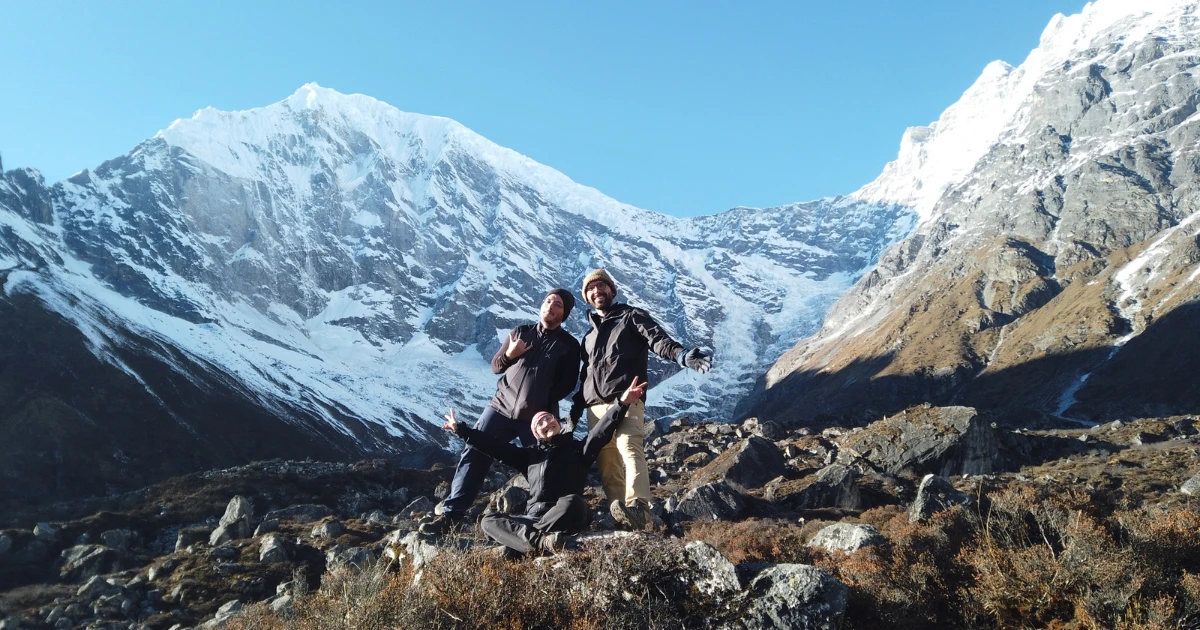
Gokyo Lakes Trek
Duration: 10 to 12 days Maximum altitude: 5,357m (Gokyo Ri) Difficulty: Moderate to challenging Trailhead access: Flight from Kathmandu to Lukla Best season: March to May, October to November Permits: Khumbu Pasang Lhamu Rural Municipality permit (NPR 3,000), Sagarmatha National Park permit (NPR 3,000 plus 13% VAT)
The Gokyo Lakes trek sits at the upper boundary of what can reasonably be called a short trek, in terms of both duration and altitude, but it belongs in this guide because it offers something that no other short route in Nepal can match: a Khumbu experience at lower altitude than Everest Base Camp, with arguably better views, without the crowds of the main EBC corridor in peak season.
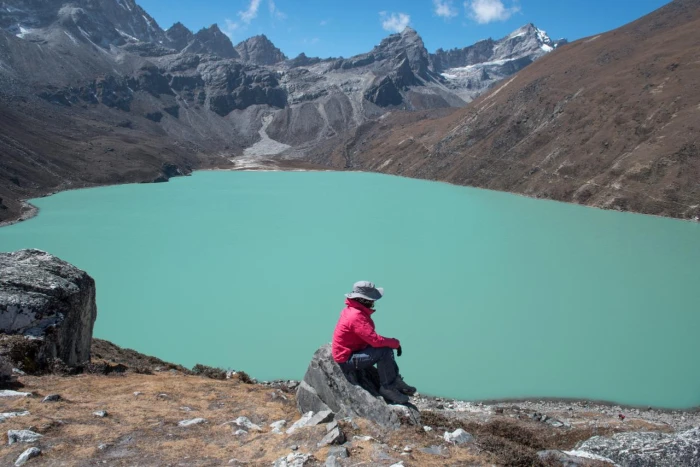
The route flies to Lukla and follows the standard EBC trail as far as Namche Bazaar before branching west into the Gokyo valley. The trail passes the Ngozumpa Glacier, Nepal's longest, and reaches the Gokyo Lakes at around 4,700 metres, a series of glacially fed turquoise lakes in a high-altitude valley with the Renjo La ridge above to the west and Cho Oyu at 8,188 metres filling the northern horizon.
Gokyo Ri at 5,357 metres is the summit viewpoint, reached in one to two hours from the Gokyo teahouses, and the panorama from the top is one of the finest available on any trek in Nepal: Everest, Lhotse, Makalu, Cho Oyu, and the full extent of the Ngozumpa Glacier visible simultaneously. It is a view that outperforms Kalapatthar for most people who have done both.
The altitude demands on the Gokyo trek are genuine. Spending multiple nights above 4,500 metres requires proper acclimatisation, and the flight-dependent approach via Lukla introduces the weather-related delay risk that affects all Khumbu trekking. For travellers with ten to twelve days who want a Khumbu experience with better views and lower EBC-corridor crowd density, this is the route.
The Gokyo Lakes trek suits: trekkers with ten to twelve days who want a Khumbu experience without committing to the full EBC circuit, those who specifically want to see the Ngozumpa Glacier and Cho Oyu, and anyone who has done EBC previously and wants to see the Everest region from a different angle.
Permits: What You Need for Short Treks in 2027
Most short treks in Nepal require two permits: the TIMS card and either an ACAP permit or a national park permit depending on the region. Both are available in Kathmandu and Pokhara without advance application and can be processed on the same day.
Trek | TIMS Card | Conservation/Park Permit | Total Approximate Cost |
| Poon Hill Circuit | NPR 2,000 | ACAP: NPR 3,000 | NPR 5,000 (approx USD 37) |
| Mardi Himal | NPR 2,000 | ACAP: NPR 3,000 | NPR 5,000 |
| Annapurna Base Camp | NPR 2,000 | ACAP: NPR 3,000 | NPR 5,000 |
| Australian Camp and Dhampus | NPR 2,000 | ACAP: NPR 3,000 (if entering ACAP boundary) | NPR 2,000 to 5,000 |
| Sarangkot | None required | None required | Free |
| Langtang Valley | NPR 2,000 | Langtang NP: NPR 3,000 | NPR 5,000 |
| Gokyo Lakes | None (NP system) | Municipality permit: NPR 3,000, Sagarmatha NP: NPR 3,390 | NPR 6,390 (approx USD 47) |
Hiking Nepal handles all permit applications as part of every guided departure. Clients provide passport copies and photographs and permits are collected by the operations team before the trek begins.
Guide Requirements for Short Treks in 2027
Nepal's No Solo Trekking regulation, enforced from 2023 onwards, requires foreign nationals to trek with a licensed guide on routes within national parks and conservation areas. This covers the majority of routes in this guide except Sarangkot and the lower sections of the Australian Camp trail outside the ACAP boundary.
For short treks specifically, the guide requirement is not only a regulatory matter. On routes like Mardi Himal, where trail markings above Low Camp are inconsistent, and on the Langtang Valley, where post-earthquake route changes have altered some sections from their pre-2015 condition, a guide with current route knowledge provides practical navigation value that maps and apps cannot reliably substitute.
Hiking Nepal assigns guides to short trek clients based on route-specific experience and language proficiency. All guides on Hiking Nepal departures are licensed by the Nepal Tourism Board and carry WAFA (Wilderness Advanced First Aid) certification as a minimum standard.
Best Time of Year for Short Treks in Nepal
Season | Months | Conditions | Recommendation |
| Spring | Mid-March to May | Rhododendron bloom, good visibility, mild temperatures | Best for Poon Hill, Mardi Himal, and Langtang |
| Pre-monsoon | Early June | Brief clear window before monsoon arrives | Manageable for lower-altitude routes |
| Monsoon | Mid-June to August | Heavy rain, leeches on lower trails, limited visibility | Not recommended above 2,500m |
| Autumn | September to November | Best post-monsoon clarity, dry trails, stable weather | Best overall season for all routes |
| Winter | December to February | Cold, quiet, clear on good days | Suitable for Australian Camp, Sarangkot, lower Dhampus. Cold but achievable for Poon Hill with proper gear. |
Spring and autumn are the two primary trekking seasons for all routes in this guide. Spring from mid-March through April is the premium window for the Poon Hill circuit specifically, because of the rhododendron bloom. Autumn from late September through October offers the clearest post-monsoon visibility and is the most popular season overall. Late October and the first week of November are particularly good for the Langtang Valley and Gokyo routes.
The winter months from December through February suit the lower-altitude options including Australian Camp, Sarangkot, and Dhampus well, with quiet trails, clear skies on good days, and genuinely cold but manageable conditions. The Poon Hill summit in January requires full winter layering for the pre-dawn ascent but is completed regularly by well-prepared trekkers.
Packing for a Short Trek in Nepal
The packing list for a short trek in Nepal is shorter than most people expect and lighter than most people initially pack. Porters carry main luggage duffels on all Hiking Nepal departures, leaving you to carry a daypack of ten to twenty litres with the items you need immediate access to on the trail.
For a four to seven-day short circuit in spring or autumn, the following covers all requirements:
Clothing and layering: Waterproof and windproof outer shell jacket; mid-layer fleece; thermal base layer top and bottom for cold evenings at altitude; two pairs of trekking trousers; warm hat and lightweight sun hat; neck gaiter or buff; liner gloves and windproof outer gloves; four to five pairs of merino wool trekking socks; waterproof trekking boots that have been broken in before the trek begins; camp shoes or sandals for teahouse evenings.
Equipment: Daypack 15 to 20 litres with a rain cover; headtorch with spare batteries; reusable one-litre water bottle; trekking poles (available for hire in Pokhara at NPR 150 per day); portable power bank; sunglasses with UV400 protection.
Health essentials: SPF 50 sunscreen applied daily above 2,000 metres; lip balm with sun protection; blister plasters; paracetamol; antihistamine; oral rehydration sachets; personal medications in sufficient quantity plus a two-day buffer.
Cotton clothing should not be worn on any section of trail above 1,500 metres. Cotton holds moisture against the skin and creates a cold and wet combination that makes temperature regulation difficult and increases the risk of hypothermia in wet or windy conditions. All base layers should be merino wool or synthetic.
Frequently Asked Questions
Do I need trekking experience to do a short trek in Nepal? Not for the most accessible routes. Australian Camp, Sarangkot, and the Dhampus walk require only a basic level of fitness and no prior trekking experience. The Poon Hill circuit requires the ability to walk five to six hours on consecutive days with moderate gradient sections, which most reasonably active adults can manage without prior trekking experience. Mardi Himal, Langtang, and Annapurna Base Camp are more suitable for travellers with some prior hill walking experience.
How fit do I need to be? A practical test for the Poon Hill circuit: walk for two hours on uneven terrain, including some uphill, without significant discomfort. If you can do this, you can do Poon Hill at a comfortable pace on the five-day family itinerary. For Mardi Himal and above, regular cardio activity three times per week for at least six weeks before departure is the recommended preparation baseline.
Can I do a short trek without a guide? Nepal's 2026 regulations require a licensed guide for all foreign nationals trekking in national parks and conservation areas, which covers the majority of routes in this guide. Sarangkot and the lower Dhampus trail outside the ACAP boundary are the primary exceptions. Practically speaking, a guide on a short trek in Nepal provides route knowledge, cultural context, permit management, altitude monitoring, and emergency response capability that have real value beyond the regulatory requirement.
What is the best short trek for a complete beginner? Australian Camp for a two-day introduction. Poon Hill for a four to five-day first proper Himalayan circuit. Both are appropriate for adults with no prior trekking experience who are in reasonable physical condition.
Can families with children do short treks in Nepal? Yes. Australian Camp and Dhampus are suitable for children aged five and above. The Poon Hill circuit is appropriate for children aged seven and above on the standard itinerary and children aged five and above on the slower seven-day family version with a porter-assist option for steep sections. Hiking Nepal runs dedicated family guided departures on both routes with guides selected specifically for family group management.
Is travel insurance necessary for a short trek? Yes. All short treks in this guide above 2,000 metres carry a small but real risk of altitude-related illness that may require helicopter evacuation. A helicopter evacuation from the Annapurna region or Langtang costs USD 2,000 to 4,000. Standard travel insurance frequently excludes trekking above 2,000 metres. A specialist adventure travel policy covering helicopter evacuation from altitude, emergency medical treatment, and repatriation costs USD 80 to 150 for two weeks and is non-negotiable for any trek in this guide above 2,000 metres.
How far in advance should I book a short trek in Nepal for 2027? For the spring rhododendron window on the Poon Hill circuit from 20 March to 15 April, book at least six to eight weeks in advance. For autumn October departures on any route, eight weeks is advisable for private departures. Outside peak windows, Hiking Nepal can confirm most short trek departures within one to two weeks and some within 48 hours on the most popular routes.
Trek with Hiking Nepal in 2027
Hiking Nepal runs private guided departures on all routes in this guide throughout the 2027 spring and autumn seasons. Every departure includes a licensed WAFA-certified guide, contracted porter at IPPG welfare standards, pre-booked accommodation at inspected teahouses, all meals on trek, all permit handling, private vehicle transfers from Pokhara or Kathmandu, and 24-hour emergency coordination.
Private family departures are available on any date. Small group joining departures run on fixed dates from mid-March through early May and late September through mid-November.
Contact Hiking Nepal on WhatsApp at +977 9802342080 (Navaraj Wagle) or at [email protected] to discuss your dates, fitness level, and group size. A personalised itinerary and cost proposal is provided within 48 hours of your initial enquiry.
The mountains are closer than you think. Several of the routes in this guide can be started the morning after you land.